Yes—some smart rings can help track your menstrual cycle by recording temperature trends and using compatible app features to estimate period dates, but they do not directly detect menstrual bleeding. In 2026, the deciding factor is the specific ring-and-app combination: a temperature sensor alone does not establish period prediction, ovulation confirmation, or suitability for contraception.
- Can a smart ring track period dates? Yes, when its app explicitly supports menstrual-cycle tracking.
- Temperature trends provide indirect cycle clues; they do not detect bleeding or directly measure reproductive hormones.
- Actxa Core Smart Ring lists sleep, activity, and recovery insights; those features do not establish menstrual-cycle tracking.
- Use cycle estimates for awareness, not as pregnancy tests, diagnoses, or substitutes for contraceptive guidance.
Can a smart ring track your menstrual cycle?
A smart ring can support cycle tracking, but recording a signal and interpreting a menstrual cycle are different capabilities. Check which of the following functions the device actually provides before buying it for period tracking.
| Tracking approach | What it provides | Best for | Main limitation |
|---|---|---|---|
| Period logging | A record of bleeding dates you enter | Keeping a menstrual history | Does not automatically detect bleeding |
| Calendar prediction | An estimated next period based on previous entries | Planning around recorded cycle patterns | Cannot account for an unexpected change before it happens |
| Temperature-informed tracking | Cycle estimates informed by temperature patterns, when explicitly supported | Adding physiological context to your records | Temperature changes have causes beyond the menstrual cycle |
| General wellness tracking | Sleep, activity, or recovery information | Understanding daily wellness patterns | Does not establish period or ovulation tracking |
These approaches can coexist in one app. An app that accepts period entries does not necessarily use the ring's sensor readings to calculate predictions, so look for an explanation of how the estimate is produced.
Why this matters
Buying a ring for menstrual tracking requires a different feature check from buying one for sleep. A device can provide useful overnight information without offering any menstrual-cycle interpretation.
Our guide to smart rings for sleep tracking addresses that separate use case. Sleep tracking alone is not evidence that a ring predicts periods.
For a 2026 purchase, separate three questions: what the sensor records, what the app calculates, and what the resulting estimate is intended to help you do. Do not treat a wellness feature as a reproductive-health feature unless the manufacturer explicitly describes that use.
That distinction also changes what success looks like. A convenient record of your periods can be useful even when it cannot reliably tell you when ovulation occurred.
How does temperature relate to your menstrual cycle?
Progesterone typically increases after ovulation and contributes to a rise in basal body temperature. That relationship explains why temperature measurements can contribute to fertility-awareness methods and cycle interpretation.
A temperature-sensing ring measures at the finger, however, rather than taking an oral basal-body-temperature reading. Peripheral skin temperature and basal body temperature are related physiological measurements, not interchangeable readings.
The app must interpret the signal within the method it supports. You should not take a finger-temperature graph and apply instructions written for a different measurement method without appropriate guidance.
A temperature shift is not a bleeding detector
Menstruation is recorded when bleeding actually starts. A ring's temperature pattern can inform an estimate, but the sensor does not observe menstrual blood.
If the app asks you to confirm your period, that entry supplies information the ring cannot obtain directly. Correcting the record matters when a prediction and your actual start date differ.
Ovulation clues are not advance guarantees
The temperature rise associated with progesterone generally follows ovulation. A pattern that helps interpret a past event is not the same as advance notice of every fertile day.
A predicted period date, an estimated fertile window, and confirmed ovulation are different claims. Read the wording attached to each feature rather than assuming that a cycle graphic provides all three.
How do you check whether a ring supports period tracking?
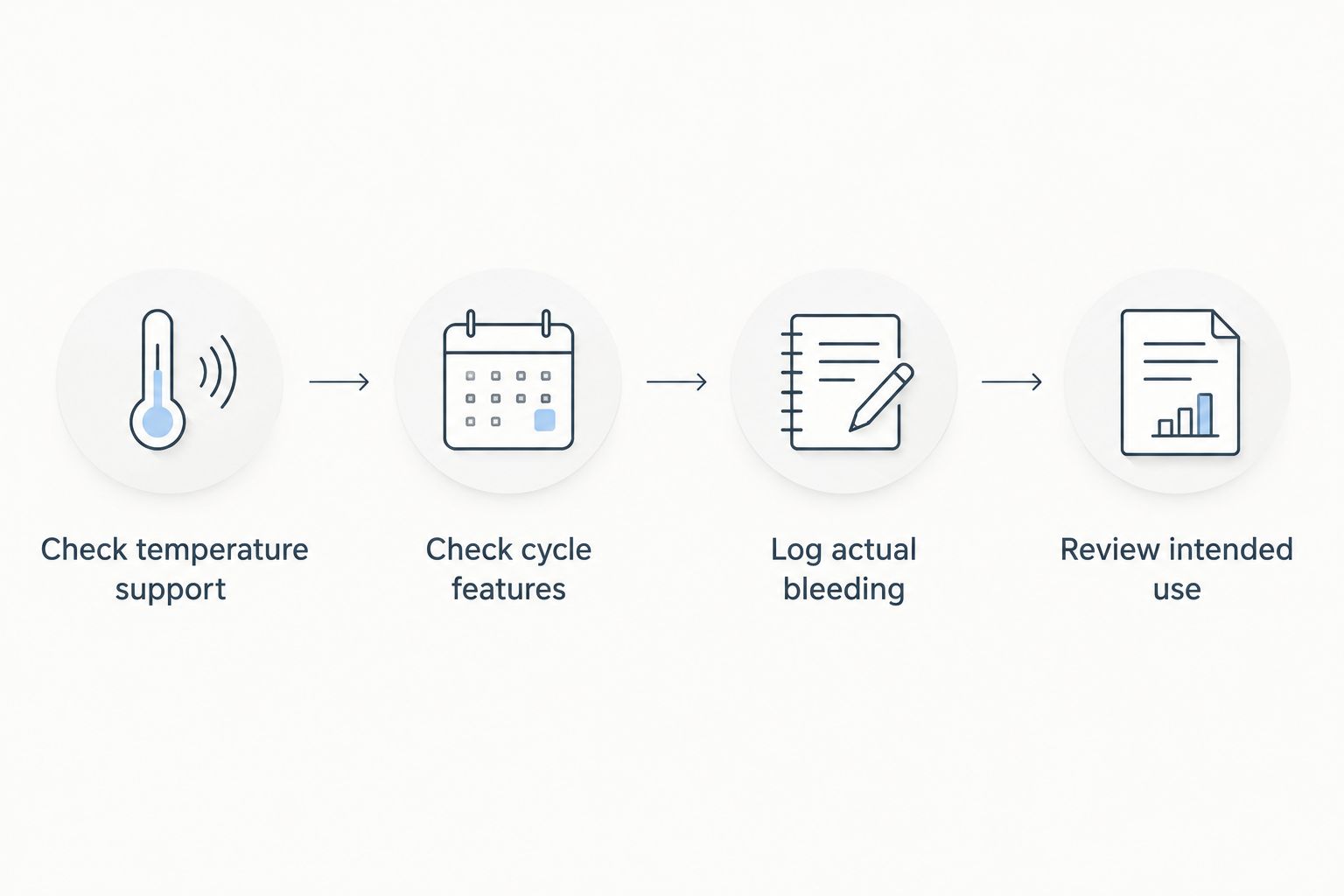
Use this sequence before choosing a ring or relying on an existing device. For a 2026 decision, check the current documentation for the exact model, app, and country in which you will use it.
- Check temperature support. Look for an explicit temperature-measurement feature. Heart-rate, activity, and sleep tracking do not establish that the ring measures temperature.
- Check cycle features. Find a specific description of menstrual logging, period prediction, or another reproductive-health function. A general reference to wellness insights is not enough.
- Log actual bleeding. If the feature uses period entries, record what happened rather than accepting the predicted date as the historical record. Follow the app's instructions for distinguishing spotting from a period.
- Review intended use. Read the limitations, supported uses, and any separate app requirements. If pregnancy prevention is your goal, check the specific method's regulatory status and instructions rather than relying on a general wellness claim.
Keep a clear distinction between a feature that exists and a feature that suits your circumstances. An app can offer cycle estimates while its instructions place limits on interpretation during irregular cycles or particular life stages.
If the documentation leaves a question unanswered, ask the manufacturer directly. Do not fill the gap with assumptions based on another ring's capabilities.
Why smart-ring cycle estimates vary
Temperature-informed estimates depend on both physiology and the available record. These factors explain why a predicted date should remain an estimate rather than a deadline.
- Illness and fever. An elevated temperature can reflect illness rather than a menstrual-cycle change. Keep that context alongside the reading.
- Sleep and measurement conditions. Changes in sleep timing, the surrounding temperature, and how the device is worn can affect peripheral temperature measurements. Follow the device's measurement instructions.
- Missing observations. An unworn ring cannot collect readings. Gaps leave less information for an app that depends on repeated measurements.
- Changing cycle patterns. A calendar prediction based on previous cycles cannot guarantee that the next cycle will follow the same timing. An unusual cycle requires a corrected record, not automatic acceptance of the forecast.
- Hormonal contraception and reproductive transitions. Contraception, postpartum changes, breastfeeding, and perimenopause can change bleeding or ovulation patterns. Check the method's guidance for your situation instead of assuming ordinary cycle interpretation applies.
For your 2026 tracking routine, annotate relevant changes when the app permits it. A temperature graph without context can make an ordinary disruption look like a reproductive-health finding.
Do not manually reinterpret every unusual reading as ovulation, pregnancy, or a medical problem. The appropriate next step depends on symptoms, actual bleeding dates, and the question you need answered.
What does Actxa Core Smart Ring establish about cycle tracking?
The supplied description of Actxa Core Smart Ring lists sleep, activity, and recovery insights. Those are wellness functions; they do not establish temperature sensing, menstrual logging, period prediction, or fertility tracking.
Actxa Core Smart Ring is best suited to shoppers seeking its stated sleep, activity, and recovery insights—not shoppers requiring confirmed menstrual-cycle tracking. Its relevant benefit is the stated wellness information, while its limitation for this purchase decision is the absence of an explicit cycle-tracking claim in the supplied description.
If menstrual tracking is essential, confirm that requirement before choosing Actxa Core Smart Ring. You can use the official Actxa store to check the current product information, but do not infer reproductive-health features from the phrase recovery insights.
The same standard applies to every manufacturer. A product's suitability for general health awareness does not establish suitability for predicting a period or managing fertility.
Can a smart ring tell you when you ovulate?
A compatible ring-and-app system can use temperature patterns to estimate cycle events, but a generic temperature trend does not confirm ovulation. The progesterone-related temperature rise generally occurs after ovulation, which limits what that signal alone tells you in advance.
If you are trying to conceive, discuss the tracking method with a qualified clinician rather than treating an app's fertile-window display as confirmation. Urinary ovulation tests and clinical assessments answer different questions from a ring's temperature graph.
Neither approach removes the need to consider your cycle history and health circumstances. An estimate can help organize observations without settling the underlying medical question.
Can you use a smart ring to avoid pregnancy?
Do not use a general wellness ring or an ordinary period prediction as contraception. A specific contraceptive method has its own evidence, eligibility requirements, instructions, and regulatory status; those do not transfer to every device that displays cycle information.
If an app claims contraceptive use, verify that exact app, its supported hardware, and its authorization in your country. Then follow that method's instructions, including what to do when measurements are missing or a day is classified as fertile.
A feature described only as cycle awareness does not meet that standard. Ask a clinician about contraception that fits your needs rather than trying to turn a wellness graph into a contraceptive method.
When should you seek medical advice instead of checking the app?
Your actual symptoms and menstrual history matter more than whether an app displays a reassuring forecast. A normal-looking temperature graph cannot rule out pregnancy or explain abnormal bleeding.
For clinical context in this 2026 guide, the American College of Obstetricians and Gynecologists' patient guidance describes a typical adult menstrual cycle as occurring every 21 days to 35 days. That reference is not a diagnostic rule for every age, contraceptive method, or reproductive stage.
ACOG's patient guidance on amenorrhea also recommends evaluation when periods stop for more than 3 months without explanation. Do not wait for that interval if pregnancy is possible, symptoms are concerning, or a clinician has advised earlier assessment.
Seek urgent care for severe pelvic pain, fainting, or heavy bleeding with symptoms such as dizziness or shortness of breath. Do not wait for a ring to classify the situation.
If your period is late and pregnancy is possible, use a pregnancy test according to its instructions. A temperature pattern is not a pregnancy test.
FAQ
Can a smart ring track period dates automatically?
Some smart rings can estimate period dates through a compatible app with explicit cycle-tracking features. The ring does not directly detect menstrual bleeding, so you still need to record or confirm actual bleeding as instructed.
Does every smart ring measure temperature?
No, temperature sensing is not a feature you should assume every smart ring includes. Check the exact model's specifications and then separately verify whether its app uses temperature for menstrual-cycle tracking.
Can a smart ring confirm that I am pregnant?
No, a smart ring's temperature trend cannot confirm pregnancy. If pregnancy is possible, use a pregnancy test according to its instructions and seek medical advice when needed.
Is a period prediction the same as an ovulation prediction?
No, a period prediction estimates when bleeding will begin, while an ovulation prediction estimates a different event. Neither label alone establishes that ovulation has been clinically confirmed.
Will cycle tracking work if my periods are irregular?
Irregular periods make predictions based on past cycle timing less dependable. Check the specific method's limitations and discuss persistent changes or concerns with a clinician.
Does Actxa Core Smart Ring track menstrual cycles?
The supplied Actxa Core Smart Ring description establishes sleep, activity, and recovery insights, not menstrual-cycle tracking. Confirm explicit support before buying it for period prediction or fertility-related use.
Can I use a cycle-tracking ring while taking hormonal contraception?
Check the specific tracking method's instructions before interpreting cycle estimates while using hormonal contraception. Hormonal contraception can change ovulation and bleeding patterns, so a standard natural-cycle interpretation does not automatically apply.
One last thing
Before choosing a ring in 2026, write down the exact result you want: a bleeding history, a predicted period date, or help with a fertility-related decision. Then require the product documentation to name that function explicitly.
The useful question is not whether a ring tracks health; it is whether its documented feature answers your particular question. Keeping those separate prevents a general wellness purchase from becoming an unsupported reproductive-health decision.