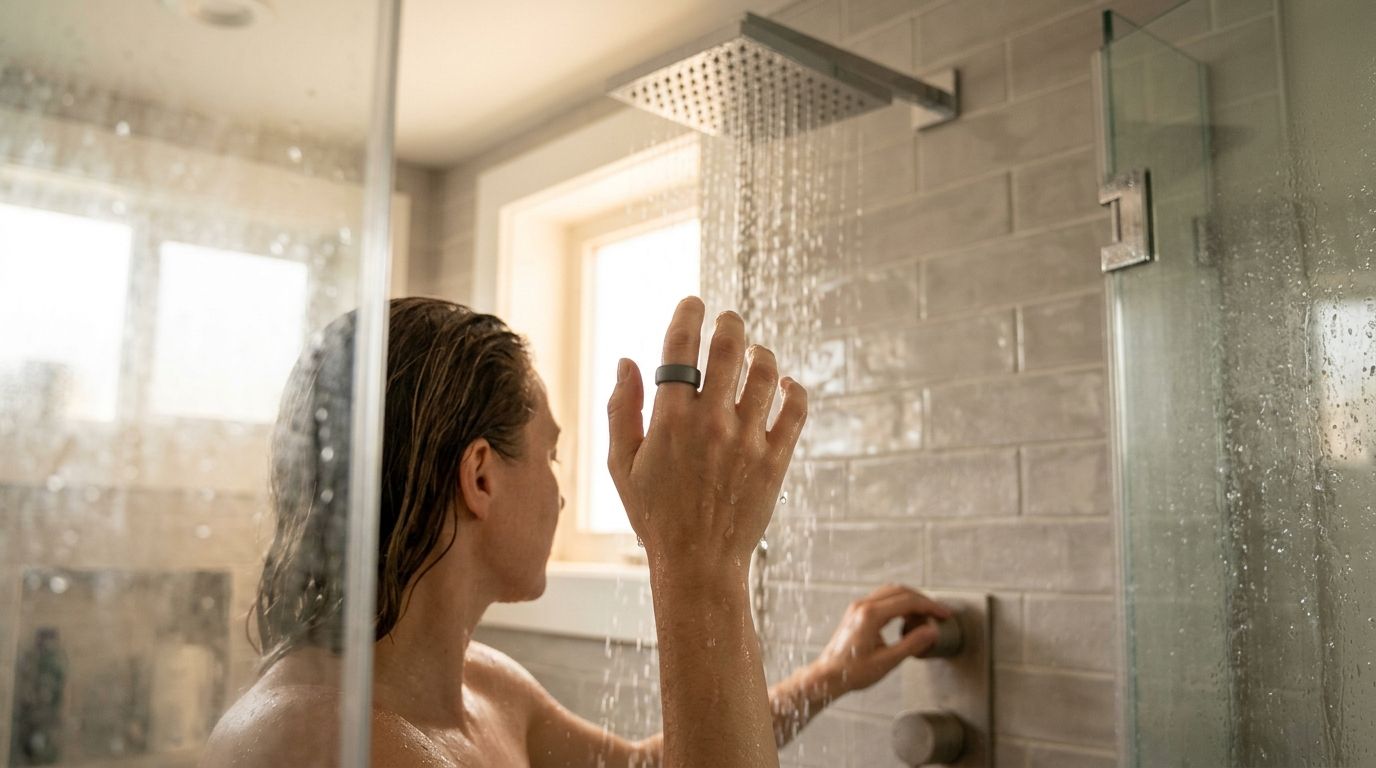
You can shower with a smart ring only if the manufacturer’s instructions for your exact model allow it; a water-resistance rating alone is not permission. Soap, heat, and direct spray are separate considerations from immersion testing. If the instructions do not explicitly permit showering, remove the ring before you turn on the water.
- Can you shower with a smart ring? Only when the manufacturer permits showering for that exact model.
- Water resistance describes test conditions, not unlimited protection against soap, heat, or shower spray.
- Actxa smart ring buyers should confirm model-specific care instructions before wearing a ring in the shower.
- After permitted water exposure, dry your ring and finger before putting the ring back on.
Why this matters
A shower combines running water, personal-care products, and changes in temperature. A rating based on controlled water exposure does not answer every question about that combination. Your decision should follow the permitted activities in the product’s care instructions, not the strongest-sounding word in a listing.
When comparing wearables in 2026, separate water resistance from permission to shower. The waterproof fitness tracker guide provides a related starting point, but the manufacturer’s instructions remain the deciding source for your device.
Can you shower with a smart ring on?
Yes, if your exact smart ring’s manufacturer permits showering and you follow its stated limits. Otherwise, take it off. Swimming permission, a water-resistance label, and shower permission are not interchangeable statements.
Use this decision table before wearing a ring into the shower:
| What the instructions say | What to do | Benefit | Limitation |
|---|---|---|---|
| Showering is explicitly permitted | Follow the stated showering and cleaning conditions | You can follow an approved use case | Permission still has limits |
| Only an immersion rating is listed | Check the activity-specific instructions | You avoid treating a test rating as blanket permission | The rating alone leaves shower suitability unresolved |
| Showering is prohibited | Remove the ring before showering | You follow the manufacturer’s care requirements | Tracking stops while the ring is off |
| The instructions are unclear | Remove the ring and ask the manufacturer | You avoid guessing about acceptable exposure | You need clarification before shower use |
Best for protecting an uncertain device: remove it. Best for keeping a permitted wearing routine: follow the exact shower instructions. Neither approach requires guessing what the enclosure can withstand.
Read instructions for the precise model you own. Similar-looking rings can have different care requirements, and a rating attached to another device does not transfer to yours.
What does a smart ring’s water-resistance rating actually mean?
Water-resistance ratings describe defined testing conditions. They do not automatically establish suitability for every activity involving water, particularly where heat, chemicals, or water jets introduce different conditions.
For a 2026 purchase, read the rating alongside the manufacturer’s activity guidance. The two pieces of information answer different questions: the rating describes tested protection, while the instructions tell you how the manufacturer permits you to use the device.
IP67: temporary immersion is not a shower approval
Under the IEC 60529 ingress-protection framework, the final digit in IP67 indicates protection against temporary immersion under specified test conditions, commonly summarized as up to 1 meter for 30 minutes. Those figures describe a controlled test, not a recommended shower duration.
The first digit addresses protection against solid particles. Neither digit tells you that shampoo, hot water, or repeated shower exposure is approved. Look for those conditions in the care instructions instead.
IP68: check the manufacturer’s stated conditions
IP68 indicates immersion protection under manufacturer-specified conditions more severe than the temporary-immersion test associated with IP67. It is commonly described as protection beyond 1 meter, but the actual depth and duration must come from the manufacturer.
IP68 is not a universal permission slip for showering. Do not assume an immersion classification also establishes protection against every kind of water jet; the IEC framework distinguishes those tests.
ATM ratings: depth is not an activity checklist
An ATM marking expresses a pressure-based water-resistance classification. A depth-equivalent label does not mean you can use a device at that depth during every activity, and it does not independently confirm shower suitability.
Read the accompanying activity guidance. If the documentation names swimming but says nothing about showering, do not fill that gap with an assumption about soap or temperature tolerance.
Why shower suitability varies between smart rings
The useful question is not whether a smart ring can encounter water. It is whether the manufacturer permits the particular exposure you are planning.
Check these factors:
- Permitted activities: Find an explicit statement about showering rather than relying on a general water-resistance claim.
- Test conditions: Identify whether the stated protection concerns immersion, water jets, or another defined exposure.
- Temperature limits: Follow any restrictions on hot water, steam, or rapid temperature changes.
- Cleaning products: Check instructions covering soap, shampoo, conditioner, disinfectants, and other substances that touch the ring.
- Device condition: Follow damage warnings and stop assuming the original rating settles questions about a visibly damaged device.
- Aftercare: Follow the required cleaning, drying, and charging precautions after permitted water exposure.
These factors are a checklist for reading the instructions, not evidence that every ring has the same restrictions. Use the requirements for your model, not a general rule borrowed from another wearable.
What should you do before and after a shower?
A repeatable routine is more useful than deciding differently each morning. For your 2026 routine, make removal the default whenever shower permission is unclear, and choose a consistent storage location away from water.
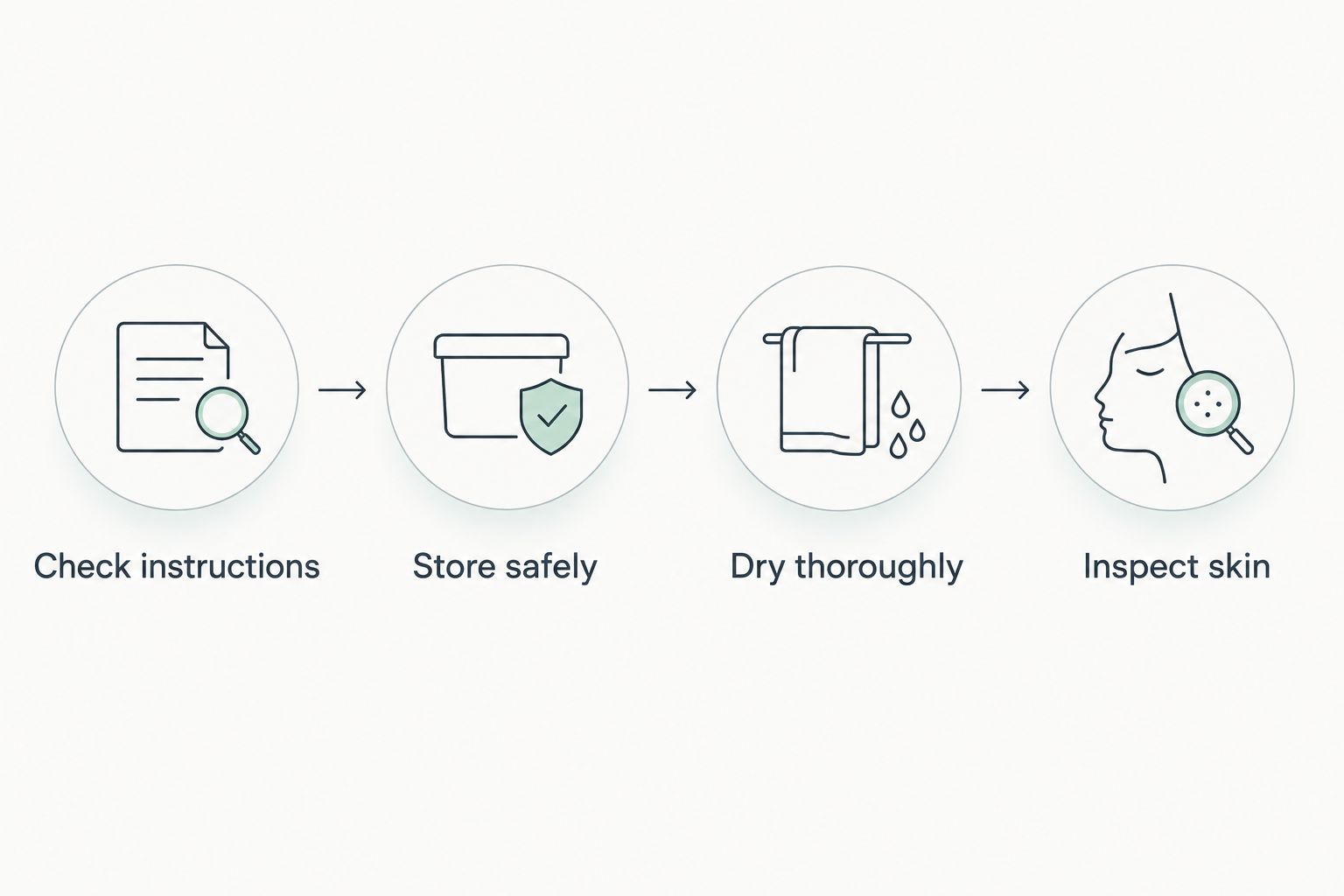
- Check instructions. Confirm whether showering is permitted and identify any temperature, product, or cleaning restrictions.
- Store safely. If you remove the ring, place it in a dry, secure location away from the sink edge and shower drain.
- Dry thoroughly. After permitted exposure, follow the cleaning instructions and dry both the ring and your finger.
- Inspect skin. Before putting the ring back on, check for lingering moisture, residue, redness, or discomfort.
The sequence separates the permission decision from aftercare. Drying a ring afterward does not make an otherwise prohibited shower exposure acceptable.
Choose storage that works when your hands are wet and your attention is elsewhere. A regular dry location makes removal practical; a loose ring beside a drain creates a different problem from water exposure.
If you use the shower interval for charging, follow the device’s charging instructions. Do not connect wet charging contacts or place a wet ring on its charger. A convenient charging opportunity does not override electrical or care precautions.
Can soap or shampoo damage a water-resistant smart ring?
A water-resistance rating does not establish compatibility with soap or shampoo. Use the manufacturer’s cleaning and chemical-exposure instructions to determine which products are permitted.
Avoid treating all cleaning products as equivalent. A direction allowing a particular cleaning method does not authorize abrasive cleaners, solvents, or disinfectants. Equally, do not introduce a homemade cleaning mixture because it seems gentle.
Residue also matters for the skin beneath the ring. Soap and moisture trapped against the skin can contribute to irritation, so clean and dry the area according to the device’s care guidance before wearing the ring again.
Can you wear a smart ring in a hot shower or sauna?
Permission to wear a smart ring in a shower does not establish permission for a sauna, steam room, or hot tub. Check each activity separately against the manufacturer’s temperature and use restrictions.
For 2026 buying decisions, avoid collapsing these activities into a single waterproof category. They involve different combinations of heat, humidity, immersion, and water treatment. A manufacturer’s approval for one activity does not approve the others.
If your instructions exclude hot water or steam, remove the ring before that exposure. Do not substitute a shorter session for a restriction unless the manufacturer explicitly provides that option.
What should you check when buying an Actxa smart ring?
Actxa is best for shoppers who want Actxa-branded wellness devices from an official direct-to-consumer store. The Actxa Core Smart Ring provides sleep, activity, and recovery insights; evaluate its shower suitability through its exact care instructions, separately from those tracking features.
Before choosing an Actxa smart ring in 2026, check these points:
- Shower permission: Look for an explicit statement covering showering, including any exclusions.
- Care requirements: Read the cleaning, drying, temperature, and charging instructions.
- Fit: Choose a comfortable fit and follow the sizing guidance rather than assuming ordinary jewelry sizing transfers directly.
- Routine: Decide where the ring will stay whenever the instructions require removal.
The relevant benefit is wearable access to sleep, activity, and recovery insights. The practical limitation is that those features do not establish permission for shower exposure. Keep the tracking decision and the water-care decision separate.
What if you already showered with your smart ring?
An accidental shower does not, by itself, tell you whether a ring is damaged. Remove the ring, follow its cleaning instructions, and dry it before further use or charging.
Check for visible damage and changes in normal operation. If the ring becomes unusually hot, appears damaged, or behaves abnormally, stop using it and contact the manufacturer. Do not attempt to dry it with an oven, hair dryer, or another heat source unless its instructions explicitly direct that method.
If the ring still works, that does not establish permission for future showers. A successful exposure is not a substitute for the care instructions, and it does not prove that repeated exposure is approved.
FAQ
Can you shower with a smart ring every day?
You should shower with a smart ring every day only if the manufacturer permits that use for your exact model. Follow all stated restrictions on temperature, cleaning products, and aftercare.
Does IP68 mean a smart ring is shower-safe?
IP68 alone does not mean a smart ring is shower-safe. It describes immersion protection under specified conditions; shower permission must come from the manufacturer’s activity and care instructions.
Should I take my smart ring off before washing my hands?
Follow your smart ring’s instructions for handwashing and soap exposure. If wearing it during handwashing is permitted, dry the ring and the skin beneath it afterward.
Can I charge my smart ring immediately after a shower?
Do not charge a smart ring while the ring or its charging contacts are wet. Follow the manufacturer’s drying and charging instructions before connecting it to power.
Is swimming permission the same as shower permission?
Swimming permission is not the same as shower permission. Check whether the manufacturer separately addresses shower spray, cleaning products, and temperature.
What should I do if my finger gets irritated under a smart ring?
Remove the smart ring if the skin beneath it becomes irritated, and clean and dry the area gently. Seek medical advice for persistent, worsening, or severe symptoms before resuming wear.
Can I use shower time to give my finger a break from the ring?
You can remove your smart ring during a shower to give your finger a break from wearing it. Store the ring somewhere dry and secure, then put it back on only when your skin and the ring are dry.
One last thing
The safest shower decision happens before the ring gets wet. A device surviving yesterday’s shower tells you what happened once, not what its manufacturer permits.
For a simple 2026 habit, keep one dry storage spot ready and use it whenever the instructions require removal or leave showering unclear. That solves the daily decision without turning a water-resistance label into a promise it never made.